
Short answer: The best dental SEO keywords are specific treatment and location phrases that match what a patient wants to do next, such as “dental implants in [city]” or “emergency dentist open today.” Sort every keyword by intent, give each one its own page, and start with the terms closest to a booked appointment.
Most practices pick keywords by guessing, or by copying the biggest phrase they can think of, like “dentist.” That rarely brings in patients. A good keyword list is built around real patient questions, your services and your service area, and it supports the work described on our local dental SEO page.
In this article
Key Takeaways
- Intent matters more than search volume. A phrase with few searches can still fill your schedule.
- Treatment plus location keywords are usually the strongest starting point for a local practice.
- Avoid broad single words like “dentist.” They are crowded and rarely tell you what the patient wants.
- Your own Google Search Console data is a free and reliable source of keyword ideas.
- Give each important keyword its own page instead of stacking everything on the homepage.
See Which Keywords You Are Missing
A free audit shows where your practice appears today and which patient searches you are not capturing yet.
What Are Dental SEO Keywords and Why Do They Matter?
A dental SEO keyword is the phrase a patient types or speaks into Google when they need dental care. It might be “teeth whitening cost,” “root canal pain” or “pediatric dentist near me.” Each phrase tells you something about the patient, and your job is to put the right page in front of them.
Keywords matter because Google uses them, along with location and many other signals, to decide which practices to show. Google explains in its own documentation that local results are based mainly on relevance, distance and prominence. Relevance starts with your pages and profile using the same words patients use.
Seed keywords versus long tail keywords
Seed keywords are short and broad, like “dentist” or “implants.” Long tail keywords add detail, like “same day dental crowns in Austin.” Long tail phrases have fewer searches, but the patient behind them usually knows what they want.
Tip: Write down the 10 treatments that bring in the most revenue for your practice first. Build your keyword list around those, not around what a generic tool suggests.
The Four Types of Patient Search Intent
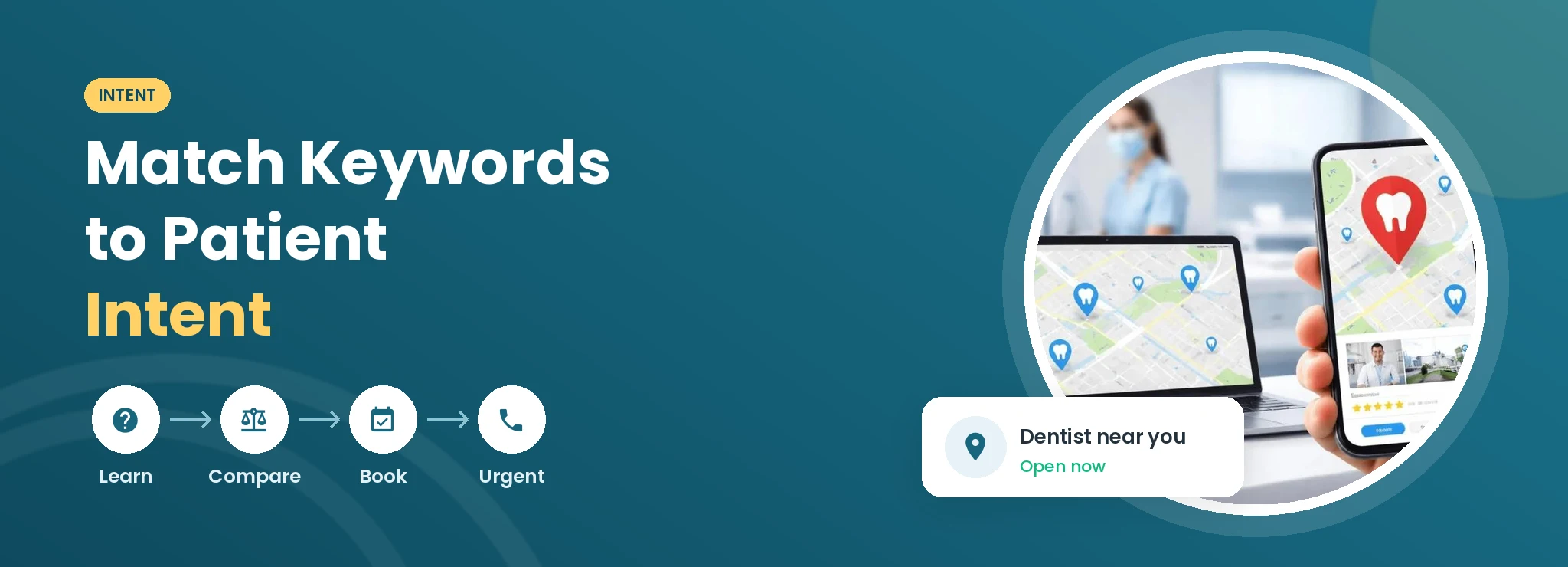
Intent is the reason behind a search. The same treatment can show up in four very different kinds of searches, and each one needs a different page. Most SEO guides group keywords into informational, commercial and transactional types. For dental practices it also helps to add urgent searches.
| Intent | What the patient wants | Example searches | Best page type |
|---|---|---|---|
| Informational | To learn | what causes sensitive teeth, how long do veneers last | Blog post or FAQ |
| Comparison | To weigh options | dental bonding vs veneers, best Invisalign alternatives | Guide or comparison post |
| Booking | To find a dentist | dental implants in [city], family dentist accepting new patients | Service or location page |
| Urgent | Help right now | emergency dentist open today, broken tooth | Emergency page and Google Business Profile |
Which intent should you target first?
Start with booking and urgent searches, because those patients are ready to call. Then add comparison and informational content to reach people earlier in their decision. Informational posts rarely book appointments directly, but they build trust and can lead readers to your service pages.
- Booking keywords go on service and location pages.
- Urgent keywords need fast, clear contact details and open hours.
- Comparison keywords suit longer guides with honest pros and cons.
- Informational keywords suit blog posts and FAQ sections.
Tip: Look at the top results for a keyword before you write. If Google shows service pages, you need a service page. If it shows articles, a blog post is the better fit.
Dental SEO Keywords by Treatment
Every treatment has its own vocabulary. Patients often search by symptom, by cost or by comparison before they ever type the clinical name. Use the patterns below as a starting point and check them against your own data.
General and family dentistry
Core terms include “family dentist,” “dental cleaning” and “dentist accepting new patients.” Add insurance terms if you take plans, such as “dentist that accepts [plan name].” Our page on general and family dentistry SEO covers how these pages fit together.
Implants, veneers and cosmetic work
These treatments are high value, and patients research them for weeks. Typical phrases include “dental implants cost,” “all on 4 implants” and “porcelain veneers vs bonding.” Many patients compare price and process before choosing, so cost and recovery content pays off. See our guide to dental implant marketing and the implant and cosmetic dentistry SEO page.
Orthodontics and Invisalign
Parents search for “braces for kids,” while adults search for “Invisalign cost” or “clear aligners near me.” Brand names matter here, so mention Invisalign only if you are a provider. Read more on orthodontist and Invisalign SEO.
Emergency and pediatric care
Emergency searches are fast and local, like “emergency dentist open now” or “knocked out tooth.” Pediatric searches often include fear or comfort, such as “dentist for anxious child.” Our post on ranking for emergency dentist near me goes deeper on the urgent side.
Not Sure Which Treatments to Push?
We will review your current rankings and point out the treatment keywords with the clearest opportunity.
How Location Changes Your Keyword List
Dental care is local, so almost every valuable keyword has a place attached. Patients add a city, a neighborhood, a zip code or “near me.” Google also uses the searcher’s location even when no place name is typed.
Do you need to write “near me” on your pages?
No. Google works out proximity from the searcher’s location and your business address, so forcing “near me” into page copy usually reads awkwardly. Focus on real place names instead, like your city and the neighborhoods you serve, and keep your Google Business Profile accurate.
Location patterns that work
- Treatment plus city: “teeth whitening in Denver”
- Treatment plus neighborhood: “cosmetic dentist in Capitol Hill”
- Dentist plus insurance plus city: “Delta Dental dentist in Plano”
- Urgent need plus city: “emergency dentist in Tampa”
Avoid creating dozens of thin pages that only swap the city name. Create a location page only when you truly serve that area and can add real details, like directions, local reviews or team members. Our Google Business Profile checklist shows how to support these pages from your profile.
Tip: Check your Google Business Profile categories and services against your keyword list. The wording there influences local results as much as your website does.
How to Research Dental Keywords for Free
You do not need an expensive tool to start. Free sources give you real patient language and show what you already rank for. Follow these steps in order.
- List your top 10 revenue treatments and the neighborhoods you serve.
- Type each treatment into Google and note the autocomplete suggestions and the People Also Ask questions.
- Open Google Search Console, go to Performance, then Search results, and review the Queries tab.
- Sort by impressions to find phrases where you appear but get few clicks.
- Check each keyword in Google Keyword Planner for rough volume, remembering local volume is smaller than national.
What to look for in Search Console
Google’s Search Console documentation notes that queries with high impressions and a low click rate can point to titles and descriptions worth improving. Queries where you sit just off page one are also good candidates for a better page or more internal links. Treat any position range as a rough guide, not a rule.
If you are not sure where your site stands, a dental SEO audit will show which of these gaps are real.
Tip: Add the weekly questions your front desk hears from callers to your list. They are some of the most accurate keyword ideas you will find.
Common keyword mistakes to avoid
The first mistake is chasing volume. A phrase with 5,000 monthly searches nationally may send you nobody, while “same day crowns in [city]” with a handful of searches may send you a patient each month. The second is targeting treatments you do not actually want more of, which fills the schedule with the wrong work.
- Targeting one huge keyword on the homepage and ignoring service pages.
- Copying a competitor’s list without checking your own services.
- Skipping cost, fear and recovery questions that patients really ask.
- Never checking Search Console after publishing a page.
Fixing these four habits is often enough to improve how your site reads to both patients and search engines, without any new tools or budget.
Where AI assistants fit in
Patients increasingly ask AI assistants plain questions like “who does dental implants near me and what does it cost?” The same approach helps here: clear service pages, honest cost explanations and consistent practice details. Our AI dental SEO page explains how this connects to your keyword work.
How to Map Keywords to the Right Pages
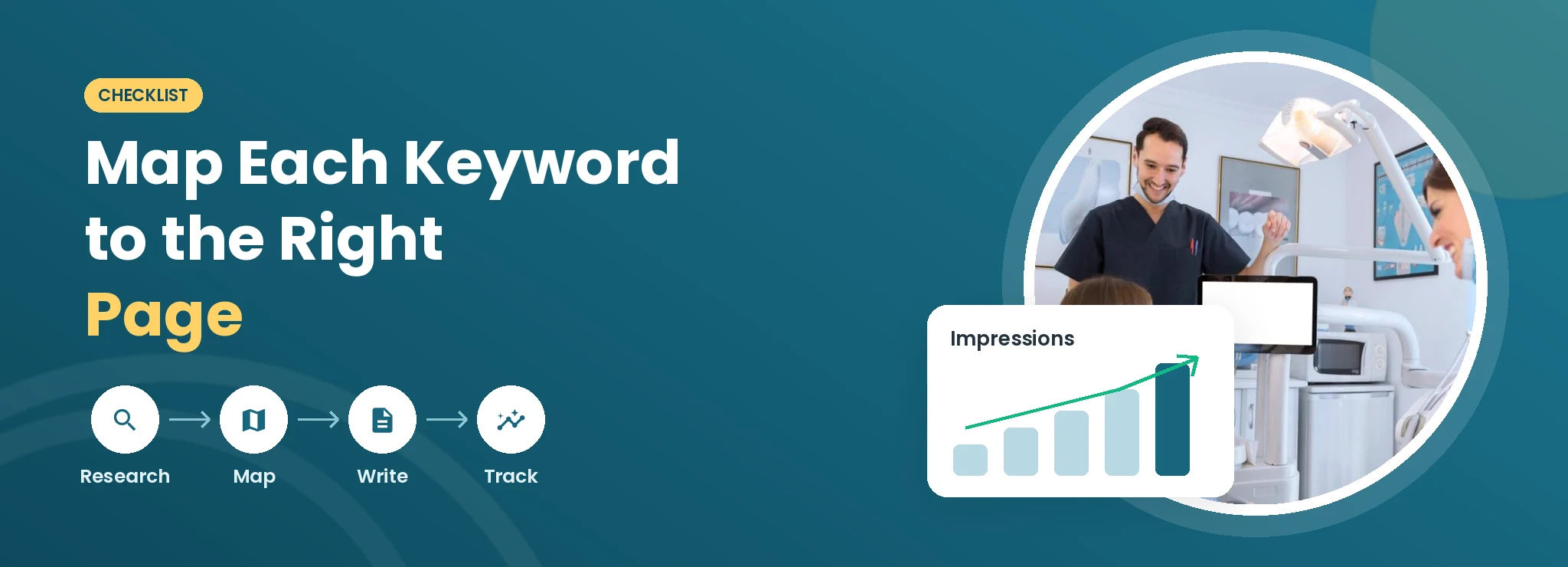
A keyword list is only useful once it is attached to pages. The rule is simple: one main keyword (plus close variations) per page, and one clear purpose per page. When two pages chase the same phrase, they compete with each other.
| Keyword | Intent | Page to target |
|---|---|---|
| dental implants in [city] | Booking | Implants service page |
| how much do dental implants cost | Comparison | Cost guide linked to the implants page |
| emergency dentist open today | Urgent | Emergency dental page |
| Invisalign vs braces | Comparison | Blog comparison linking to the Invisalign page |
| what to expect at a first dental visit | Informational | FAQ or new patient page |
A quick mapping checklist
- Put the main keyword naturally in the title tag, H1 and first paragraph.
- Write for the patient first, and use variations the way people speak.
- Link supporting posts to the matching service page.
- Review results every quarter and update pages that slip.
Keep expectations realistic. Rankings depend on competition, your reviews, your site and many other factors, so no keyword list guarantees a position.
The Bottom Line
The best dental SEO keywords are not the biggest ones. They are the phrases that match a real patient need in your service area, matched to a page that answers it. Start with booking and urgent searches for your top treatments, then build outward. Our local dental SEO service is built around exactly this process.
Ready to Build a Smarter Keyword Plan?
Request your free audit and we will show you where the best patient searches are hiding.
 10 years in dental SEO
I’m James Wilson, a dental SEO specialist with ten years of experience. I help dentists show up higher on Google, get found by patients in their area, and turn website visits into booked appointments. My work covers local SEO, keyword research, Google Business Profile optimization, and website content written for dental practices. I also share straightforward SEO tips that help dentists with everyday marketing problems, stand out from nearby competitors, and reach the patients who are searching for the care they offer.