

Dental practices fight for the same handful of local searches every year, and dental SEO marketing still wins more of those fights than paid ads or referrals alone. Search habits keep shifting toward AI results and voice queries. But the real work behind visibility, trust, and new patient calls has not changed much. Here are ten ideas that still bring results in 2026, with steps you can start this month. None of these require a huge budget. They require attention and a bit of consistency, which most practices struggle to keep up on their own.
Want to see where your practice stands online right now? Request a free visibility check and get a clear starting point.
1. Build a Solid Dental SEO Marketing Base
Every idea below depends on this one. A slow site, missing schema markup, or a messy page structure blocks Google from understanding what your pages offer. Fix that first, or nothing else on this list matters much.
Start with a full technical audit. Fix broken links. Shrink oversized images. Check that your site loads fast on a phone, not just a desktop screen. A solid dental SEO marketing base also means your practice name, address, and phone number match exactly across your website and every directory listing. Small mismatches like these quietly drag rankings down, and most practices never notice.
Many practices skip this step because it feels invisible compared to a new blog post or a flashy homepage redesign. But search engines crawl your site constantly, and every broken link or slow-loading page chips away at trust in the background. A clean base does not win rankings by itself. It clears the path so everything else you do actually counts.
2. Prioritize Search Engine Optimization for Dentists
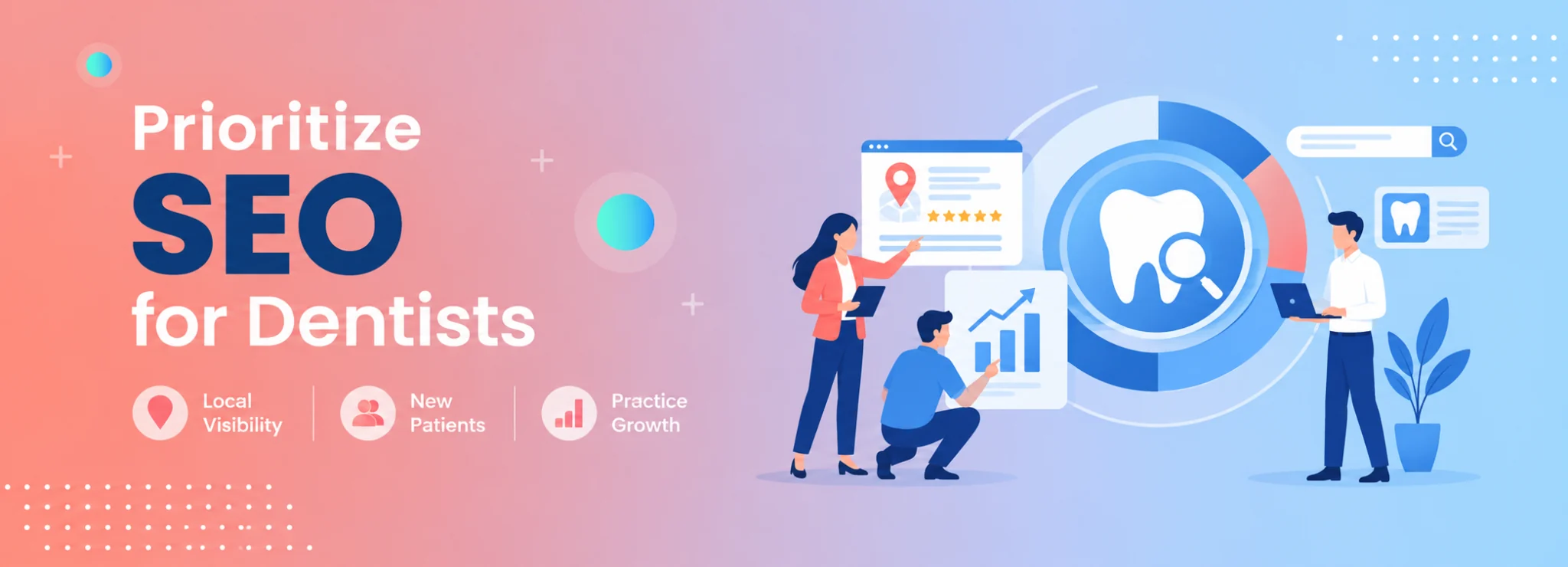
Generic SEO advice rarely fits a dental practice. Search engine optimization for dentists works differently because patients search with urgency and real pain points behind their queries. They type things like “emergency dentist near me” or “gentle dentist for kids,” not broad industry terms.
Build each service page around one procedure and one location. A page titled “dental implants in [city]” beats a vague implants page nearly every time, because it matches the exact phrase a patient types when they finally decide to book.
Think about the difference between a patient searching “how much do braces cost” versus one who types “orthodontist near me open Saturday.” Both need an answer, but each one sits at a different point in their decision. Your site needs pages built for both moments, the early research phase and the ready-to-book phase, or you lose one group while you chase the other.
3. Invest in Dental Content Marketing
Blog posts, patient guides, and short videos still bring steady traffic month after month, long after you publish them. A consistent dental content marketing habit tells Google your site knows what it talks about, not just that it exists.
Answer the questions your front desk hears every week: cost, recovery time, insurance coverage, and how one treatment compares to another. Clear answers to those questions often land in a featured snippet, the box that sits above the regular search results.
Content does not need to read like a textbook to work. A short guide that walks a nervous patient through what a root canal actually feels like, written in plain language, often performs better than a clinical overview stuffed with medical terms. Patients search for reassurance as much as they search for facts, and content that speaks to both tends to hold attention longer, which search engines notice too.
Did You Know?
Google often pulls featured snippet answers from a single short paragraph, not a whole article. A tight two- or three-sentence answer near the top of a page has a real shot at that spot.
4. Add Dental AI Marketing Tools to Your Workflow
Dental AI marketing tools now handle tasks that used to take entire afternoons. They draft content outlines, flag technical SEO problems, personalize follow-up emails, and spot trending keywords before your competitors notice them.
Use these tools to speed up research and drafts, not to replace a real person’s judgment. Patients can spot generic writing within a sentence or two. Let AI do the heavy lifting up front, then have someone on your team edit for accuracy and tone before anything goes live.
The practices that get the most from AI treat it like a fast first-draft machine, not a finished product. A tool can pull data, spot patterns, and suggest angles far quicker than a person working alone. But it still needs a human to check facts, add a local touch, and make sure nothing sounds stiff or out of place next to your practice’s actual voice.
| Task | Old Way | AI-assisted way |
|---|---|---|
| Keyword research | Manual spreadsheet checks | Real-time trend alerts |
| Content drafts | Written from scratch | AI outline, human edit |
| Review replies | Typed one by one | AI draft, staff approves |
| Rank tracking | Weekly manual checks | Automated daily reports |
Not sure which tools fit a dental practice budget? Book a quick strategy call and get a straight answer.
5. Claim and Optimize Google My Business for Dentists
Your listing on Google My Business for dentists often shows up before your website does. Treat it with the same care you give your homepage. Fill out every field: services, hours, insurance you accept, and real photos of your office and team, not stock images.
Post updates every week. Reply to every review, even the short ones. Keep your categories accurate. Practices that touch their listing weekly hold stronger local map positions than practices that set it up once and never look at it again.
A profile with real photos, current hours, and recent posts signals an active practice to both patients and Google. An empty or outdated profile does the opposite, even if the practice behind it runs smoothly. Patients judge trust fast, often in the few seconds before they even click through to your website.
6. Strengthen Your Dental Web Design
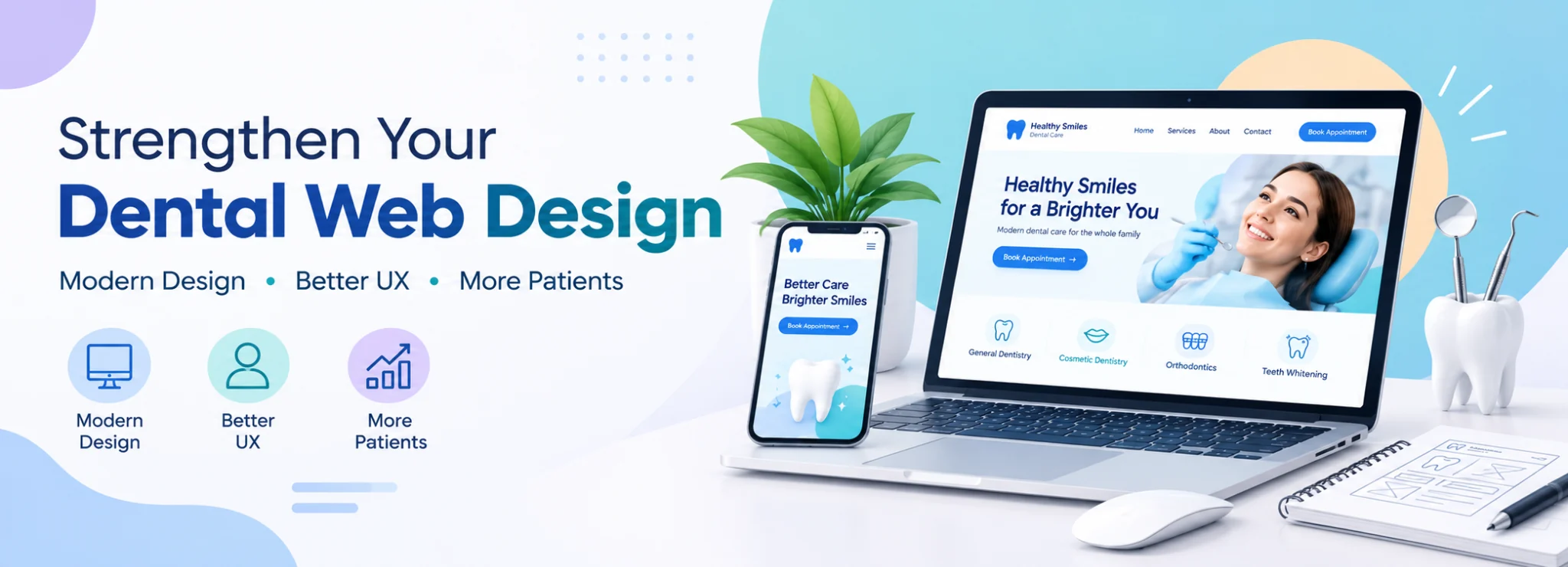
A cluttered or outdated site pushes patients straight to a competitor’s tab. Clean dental web design matters for both search rankings and how many visitors actually book. Google rewards fast, mobile-friendly pages, and patients reward simple booking steps with real appointments.
Keep your menu short. Put your phone number and a booking button near the top of every page. Cut any pop-up that blocks the screen on a phone. A page that loads in under three seconds keeps far more visitors than one that drags.
Good design also means the site works the same way for a first-time visitor as it does for a returning patient who just wants to reschedule. Confusing menus and buried contact pages push both groups away, and every visitor who leaves without booking is one Google notices too, since search engines track how people behave once they land on a page.
7. Grow Through Dentist Social Media Marketing
Search visibility and social presence overlap more now than they did a few years back. Dentist social media marketing builds recognition and trust, and patients often search your practice name directly after seeing a post about you.
Post short clips: before-and-after shots, quick tips, and staff introductions. Skip the long, polished videos. Three short posts a week beat one elaborate post a month, and they keep your practice in front of people who scroll past everything else.
The goal is not to go viral. It is to stay visible enough that when someone finally needs a dentist, your name already feels familiar. That familiarity shows up later as a direct search for your practice name, which is one of the strongest trust signals a local business can build.
- Post short clips instead of long videos
- Reply to comments and messages within a day
- Tag your location on every post
- Share patient testimonials, with permission
8. Keep Managing Online Reputation a Priority

Reviews shape both patient trust and local rankings. Managing online reputation deserves a spot on your calendar every week, not just attention after a bad review shows up. A steady stream of fresh reviews tells Google your practice stays active.
Ask happy patients for a review right after a good visit, while the experience still feels fresh. Reply calmly to every review, good or bad. Your response often matters more to future patients than the original comment did.
A single bad review does not sink a practice. A pattern of ignored reviews does. Patients read replies as closely as they read the reviews themselves, and a calm, specific response to a complaint often builds more trust than a page full of five-star ratings with no engagement behind them.
9. Ask What Dental SEO Marketing Looks Like in 2026
So what does real dental SEO marketing look like this year? It blends technical accuracy, AI-assisted research, local relevance, and honest trust signals like reviews and social proof. Agencies such as Dentist SEO Experts point to this same mix when they explain why some sites rank and others stall out.
Search engine optimization for dentists now weighs page experience and answer accuracy more than keyword count ever did. Practices that treat SEO as a habit, not a one-time project, hold their rankings through algorithm updates that knock weaker sites down.
| Ranking Factor | Weight in 2026 | What to Do |
|---|---|---|
| Page speed and mobile experience | High | Test monthly, fix fast. |
| Review volume and reply rate | High | Ask after every visit. |
| Content depth and accuracy | Medium to high | Update old pages twice a year. |
| Local listing consistency | Medium | Audit listings each quarter. |
10. Track Results and Adjust Your Strategy
None of these ideas work well alone, and none stay effective forever without a second look. Check your rankings, call volume, and form submissions every month. That’s the only way to see what actually moves the needle for your practice.
Drop what stalls. Put more budget behind what works. A practice that reviews its numbers monthly adjusts faster than one that waits for an annual report, and that speed often decides who wins the local search results.
Tracking does not need to be complicated. A simple monthly log of new patient calls, where they found you, and which pages brought in the most traffic tells you far more than a complex dashboard full of numbers nobody checks. The practices that grow steadily are usually the ones that look at their numbers often enough to catch a problem before it becomes a pattern.
Bonus: Watch How AI Search Results Change the Game
Search results in 2026 look different than they did even two years back. Google now shows AI-generated summaries at the top of many searches, sometimes before a single normal link appears. That box pulls its answer from a real page somewhere, and your practice wants to be the source it picks.
Write clear, direct answers near the top of your pages, before you add detail below. A short, plain sentence that answers the question fast has a better shot at that summary box than a long, winding paragraph. This one shift matters more each year, and practices that ignore it will lose visibility even while their older rankings stay put.
This shift also rewards practices that keep their content current. An AI summary tool tends to pull from pages that feel fresh and accurate, not ones sitting untouched for years. A quick review of your older pages twice a year, updating a stat here or a service detail there, keeps your content in the running for these new AI-powered results.
Pro Tip:
Read your own page out loud and ask if it answers the main question in the first two sentences. If it takes a full paragraph to get there, an AI summary tool will likely skip your page for a competitor’s.
Conclusion
Dental SEO marketing in 2026 rewards practices that treat it as a steady habit, not a quick fix: a clean technical base, strong content, active reputation work, and honest tracking. Teams like Dentist SEO Experts describe this same combination when they talk about what actually keeps a practice visible long-term. Commit to these ten ideas and most practices and see stronger call volume and more booked appointments within a few months.
If your team needs an extra hand with all ten of these areas. Reach out for a free consultation and find out where to start.
 10 years in dental SEO
I’m James Wilson, a dental SEO specialist with ten years of experience. I help dentists show up higher on Google, get found by patients in their area, and turn website visits into booked appointments. My work covers local SEO, keyword research, Google Business Profile optimization, and website content written for dental practices. I also share straightforward SEO tips that help dentists with everyday marketing problems, stand out from nearby competitors, and reach the patients who are searching for the care they offer.